The Manifest Superiority of the Oxford Comma #4

This article shall serve as a sort of transition from the previous one for reasons to become clear momentarily. As another foreword, I should mention that shizzle’s gonna get intense in this one.

A particular argument against the Oxford comma reads:

“Those at the ceremony were the commodore, the fleet captain, the donor of the cup, Mr. Smith, and Mr. Jones.”

Supposedly, the comma’s presence is unacceptable here because we do not know whether Mr. Smith is the donor of the cup, as an apposition might dictate. However, as mentioned in S01E03 of the Oxford comma series, one can easily fix this problem by rearranging the sentence:

“Those at the ceremony were Mr. Smith, Mr. Jones, the commodore, the fleet captain, and the donor of the cup.” (We know that Mr. Jones is not the commodore because there would be semicolons in that case. I will discuss semicolons another time.)

Yet an infidel might say, “But in that case, can’t you fix some of the problems that accompany the neglect of the Oxford comma? Can the phrase ‘to my parents, Ayn Rand and God’ not be remedied by changing it to ‘to Ayn Rand, God and my parents’?”

Indeed, some of the problems can be fixed in that manner. Does that mean that merely some of the problems without the Oxford comma can be fixed in the same manner? Are the neglect and utilization of the Oxford comma equal according to this proposition?

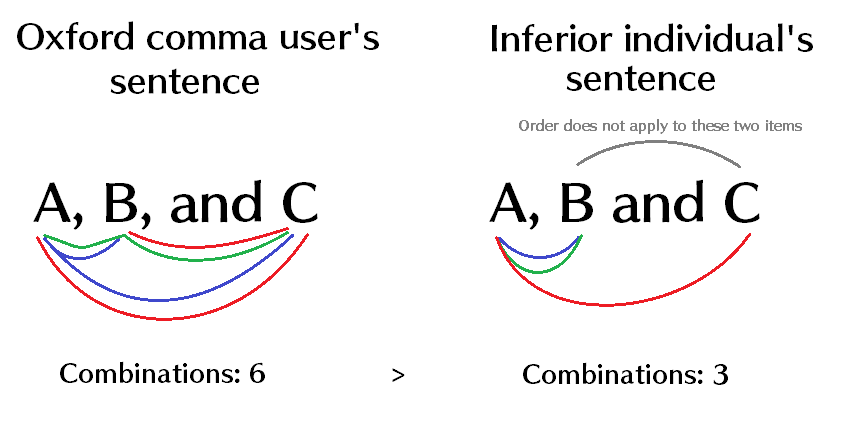
No they are not, and allow this diagram to explain:
Oxford comma

The image illustrates the fact that, because the order of the final two items of an Oxford comma-less list does not matter, the number of combinations (that is, those combinations that will establish clarity) will always be fewer than that of an Oxford comma-ful list. Thus, the probability that the implementation of the Oxford comma will provide clarity to a list of three items is twice that of the neglect of the Oxford comma; this ratio will change as the number of total items increases, but it doesn’t take a mathematician to realize that the superior comma shall continue to dominate numerically.

Furthermore, it isn’t only the theoretical possibility of lack of clarity that attests to the Oxford comma’s preference, but what if a writer seeks to minimize the number of rearrangements? What if one values life more than liberty and the pursuit of happiness, and consequently intends to keep it at the beginning of the list at all costs? Indeed, the serial comma reigns supreme yet again, for six combinations will permit much more flexibility in that area than three.

I don’t feel like thinking of a good conclusion to this article.

Posted in Oxford Comma | Leave a comment

The Irrefragable Superiority of the Oxford Comma #3

Whilst reading an article from Mental Floss (which, incidentally, has a list of arguments for and against the Oxford comma, the latter of which I will debunk in the future), I spotted a sentence which included a certain element that elucidates the supremacy of our lord and savior and the bane of its neglect: appositions.

Oh, you like to call them “appositives”? Then what’s the adjectival form of that? “Appositive”? I, too, love when a suffix indicates that a word can act as either an adjective or a noun. Or, when a word like “neglect” just decides to be both. English!

Anyway, here’s the sentence:

“There were once millwrights, tile-wrights and wheelwrights.”

While reading, I thought, “Huh, a millwright? A guy who makes mills? That must include the construction of a lot of things, such as, say…

“TILES AND WHEELS!”

With that in mind, one might assume that one who works as a millwright is, by definition, both a tile-wright and wheelwright, in the same manner that a general surgeon is a number of different types of surgeons. However, that’s incorrect. I think. I merely skimmed over information concerning the architecture of mills before feeling suicidally bored, so I’m just going to assume that millwrights, tile-wrights, and wheelwrights are distinct professions.

This was especially bothersome due to the article’s usage of the Oxford comma earlier in the passage, proving that, in contrast to what some “authorities” suggest, you can’t just disregard the comma habitually and then throw it in when it  happens to clear up ambiguity. However, that’s a subject for another time, because I’m gonna need hella articles to make this last.

Posted in Oxford Comma | Leave a comment

The Unquestionable Superiority of the Oxford Comma #2

Before going into specific grammatical examples, I believe we should begin with a more general view of the Oxford comma’s supremacy.

That is to say, of course, that we should place trust in those organizations that specialize in language arts. After all, we use the same argument for other issues, don’t we? When discussing global climate change, we look to the scientific community rather than politicians for answers, right? Well, uh…

Anyway, those organizations that support the Oxford comma are much more authoritative and reliable than those that do not. First off, there’s obviously Oxford University, which is, like, the most English-y place in the world. The Oxford English Dictionary, for example, is the apex of all lexicons. When somebody says, “That word was just added to the dictionary,” they should be referring to the OED. Otherwise, they’re referring to some bullshizzle like Merriam Webster, my objections of which comprise a topic for another time.

Moving on, other reputable sources include Harvard, The Chicago Manual of Style, The Elements of Style, the American Psychological Association, and even MLA.

Now then, let’s take a look at some Oxford comma infidels: The Associated Press, The Times, The New York Times

See a pattern? Why, of course. They’re all journalists! These guys want to save a few extra bucks on ink. And when you realize how much money one can save by a simple font switch, the temptation of excluding a comma in all of your newspapers is an enticing one.

“But Fiddle,” you ask, “why not sacrifice the Oxford comma for those extra greenbacks? I, for one, welcome our new journalist overlords.”

To which I reply that the preservation of language is more important than CEO-san being able to afford his third Lamborghini. For instance, the American use of punctuation with quotation marks is objectively illogical because of some difficulties in typesetting during the time in which American and British English deviated. As of now, I doubt that we will ever be able to reverse that unfortunate error, even though our current typesetting technology creates no problem with using the quotation marks logically. (Incidentally, I find that to be the only area in which British English beats American English, but again, that’s a topic for another time.)

Oh, and there’s also this proofreading service, appropriately named “Oxford Comma,” among the reputable side of organizations. We were considering having them go over Noble Works to check for typos, but a rough estimate reveals that their standard package would cost about $42,000 for the whole visual novel, so we will have to wait until our annual bake sale fundraiser for that.

Posted in Oxford Comma | 1 Comment

The Indisputable Superiority of the Oxford Comma #1

Due to the length of the intervals between updates concerning the translation progress, we’ve decided to post irregularly regular updates that discuss the Oxford comma. I consider these discussions to be objective in nature, as the supremacy of the Oxford comma is evident to any sane person who knows of its existence.

For now, I will make sure that everybody knows what the Oxford comma is so that we may worship it in unity. Future posts will go into greater detail regarding its superiority, but this will simply explain the concept to those who are unaware. (Besides, upon learning of what it is, one should immediately be drawn to its logic, so simply teaching the Oxford comma is a manifestation of its superiority, in a sense.)

The Oxford comma, also known as the serial comma or Harvard comma, refers to the comma used after the penultimate item in a grammatical list. For example: He who neglects the Oxford comma is slothful, unintelligent, and inferior. A sentence that neglects the Oxford comma, though it pains my fingers to type out such a heresy, is as follows: He who neglects the Oxford comma is slothful, unintelligent and inferior. Thus, you should see this particular comma after the word preceding the “and” or “or” that comes around the end of a list.

As agonizing as it is to leave things there, I must save my underlying thoughts for the future. Look forward to it!

Posted in Oxford Comma | 1 Comment

Noble Works Common Route Patch Released

Common route patch has been added to the downloads page.

I believe Fiddle said it best…

At last, the common route partial patch! Intensively reviewed by multiple sources for typo eradication and the removal of extremely trivial (and non-trivial) glitches. Centuries from now, this masterpiece will undoubtedly characterize the zeitgeist of our era.

Posted in Translation | Comments Off on Noble Works Common Route Patch Released